Tags
The Las Vegas Experience(s)
Going to a live performance by Jeff Dunham had been on my Bucket List ever since the first time I saw him on TV. In my opinion, no better ventriloquist exists on this planet, period. When my son, Geoffrey, told me Dunham was going to be in Las Vegas and suggested we ‘might’ want to make the four-hour drive over to see him perform, I immediately began planning the logistics for hitting the highway within the hour.
Geoff had been working on the trip plans already. He suggested we spend a few days in Las Vegas to see more than one event. What follows here is a capsule of four days beginning with checking in at Binion’s Casino’s haunted Hotel Apache. In the trip planning Geoff and I agreed that we didn’t need a plush experience. All we needed was a place to sleep.
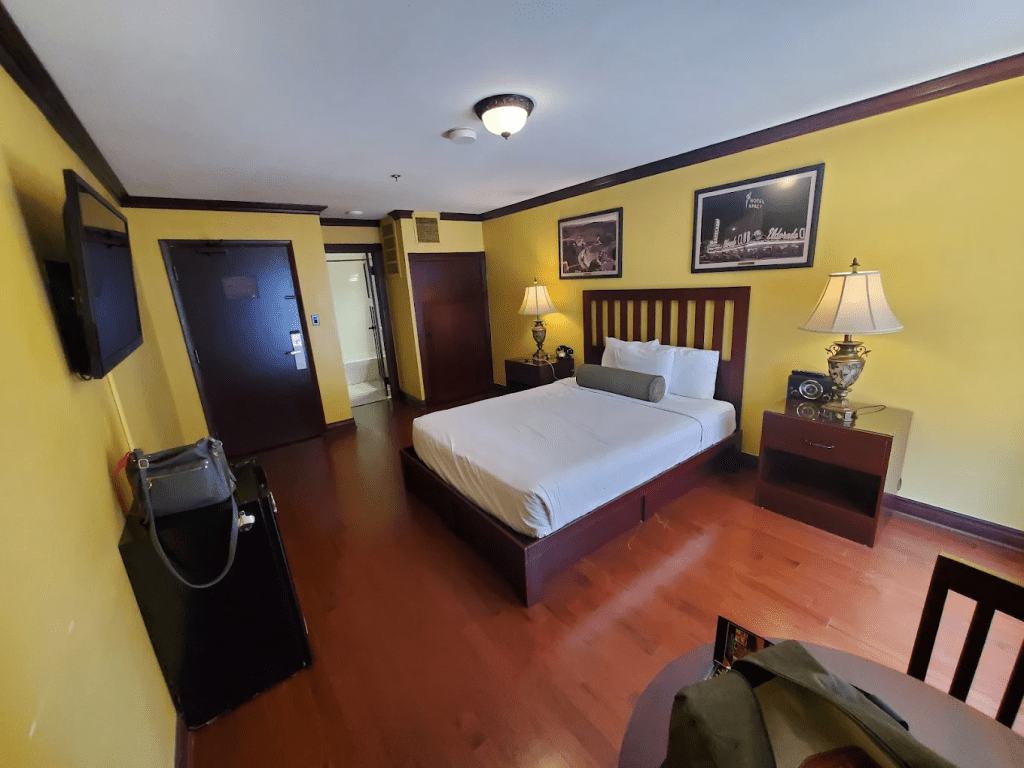
According to the legends, Binion’s Hotel Apache is haunted. According to the lore, Hotel Apache opened its doors to the public in 1932 as a place of retreat for workers building the Hoover Dam. The rooms show their age, but they had en suite facilities and no traces of bed bugs. The better of the two, my room, featured a mini-fridge. That, a queen-sized bed, one wooden chair, and a dinette table constituted the furnishings. We wouldn’t have time to lounge around a pool, neither of us played golf, and the garden atmosphere that others paid significant luxury fees for were avoided. It wasn’t, definitely wasn’t to save the cash. We had early on agreed to avoid, as much as possible, the tumultuous traffic on the strip by relying on Uber and Lyft. After collecting our luggage my car was left to collect dust on the second level of Binion’s parking structure.
Saving the best for last, like dessert after a meal, wasn’t what we came here for. We’re here for:
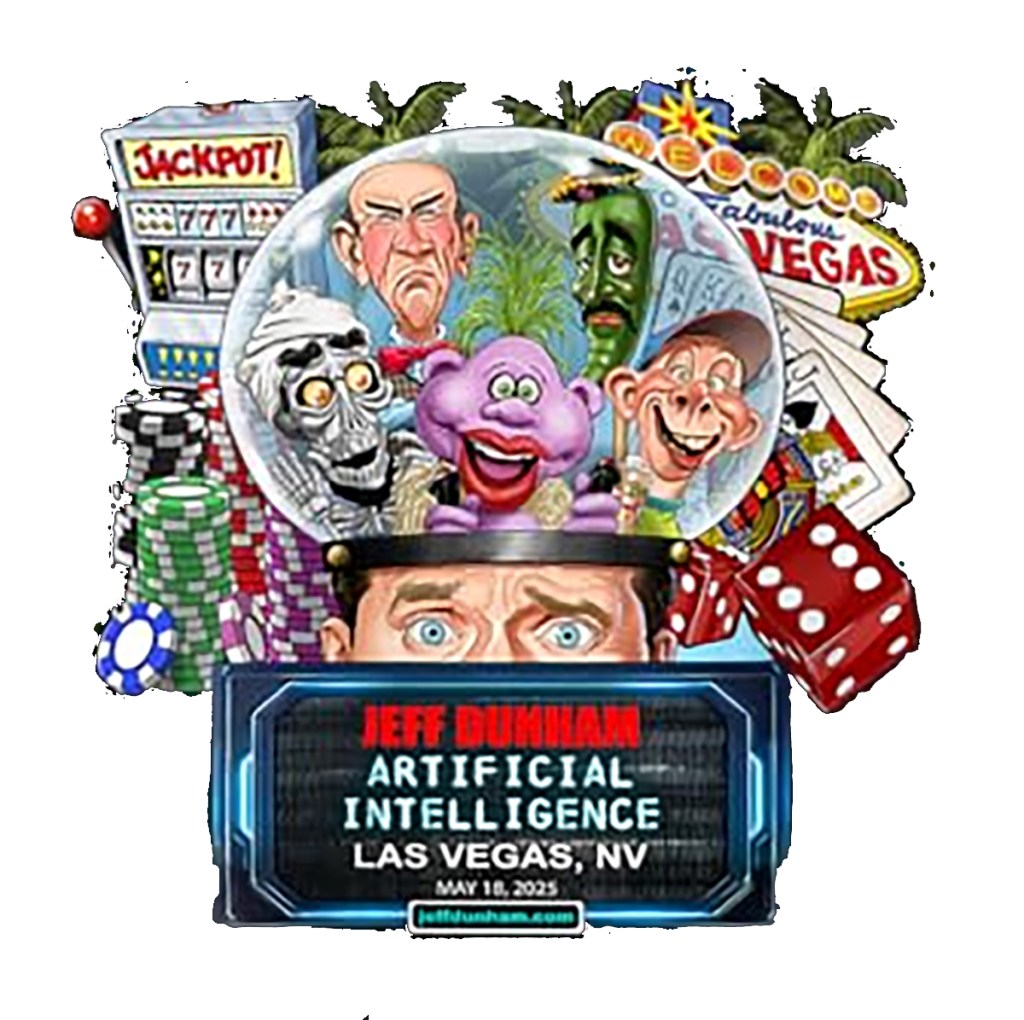
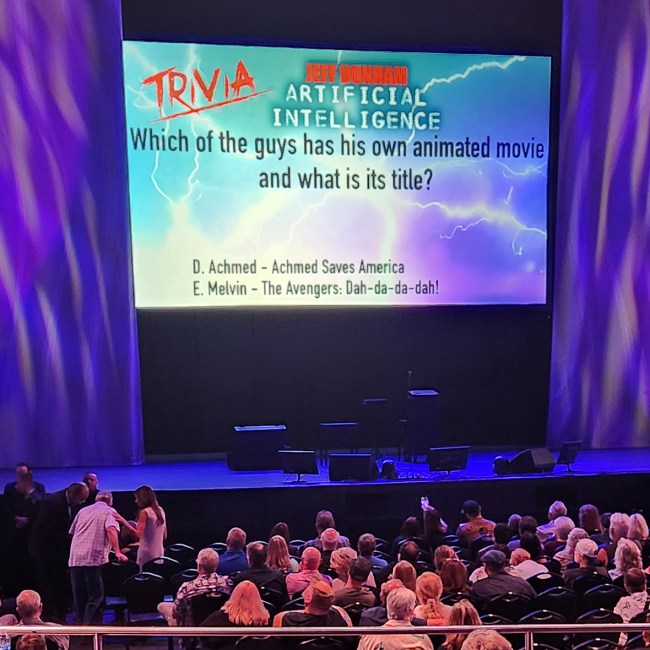
Jeff Dunham and his family of characters (I refuse to call them dummies) entertained us for ninety minutes of history and comedy. While the audience was being seated we were entertained by a slide show projected on a huge screen above the stage. Most of it was trivia interspersed with scrambled word puzzles relating to Dunham’s travels and adventures. A recorded voice boomed out telling us we were not allowed to record or take photos during the performance, yadda, yadda, etc., on penalty of ejection from the theatre and copyright lawsuits. So any images in this part of the blog are strictly your imagination. The advertised show starting time was 7:00PM. Geoff and I were seated well ahead of that time. It seemed like people just kept pouring in. I’m sure it was after 8 before the house lights dimmed and Dunham stepped into the spotlights to do his opening monologue. Sound recording was out of the question and wouldn’t attempt to include it here in any case. I will say he has lived an extraordinary. Along with his pals he probably has more visas than one passport could contain. I suggest you Google/Facebook for his name and taping of his show.
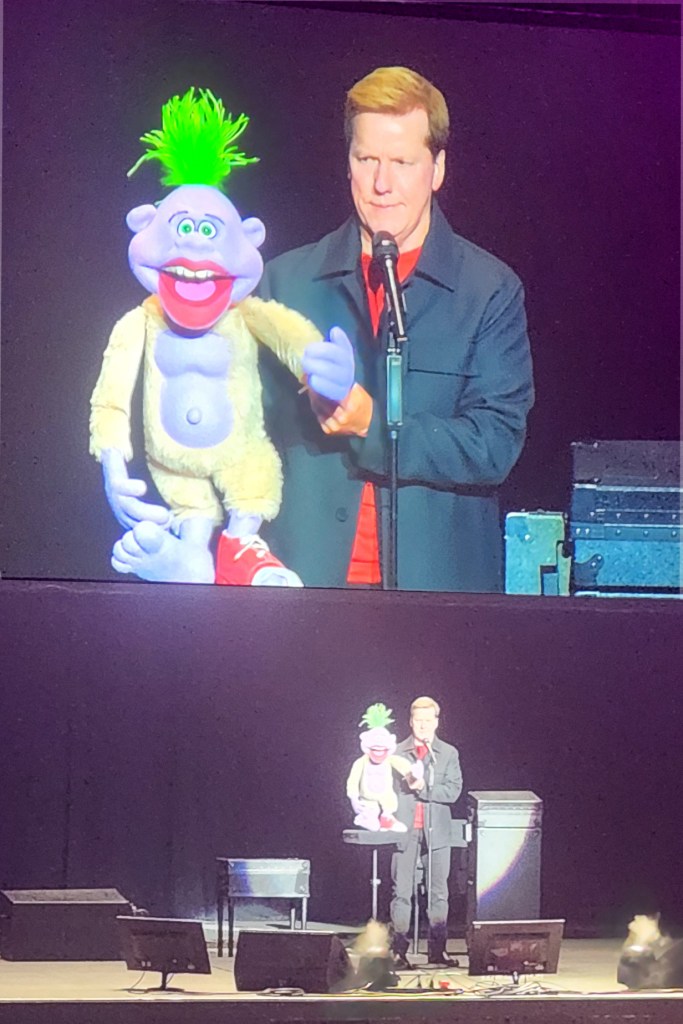
First of all, it was difficult enough to acquire these imaginary images you’re seeing, and we just couldn’t get them all. Besides that, to properly show case all five characters (plus one I’ll show later) I think would be like sitting you all down in the living room while I drag out the 35mm slide projector for a marathon evening. For me, Peanut, the one on the left, not the one behind the microphone, makes me laugh the most. His one-liners, facial expressions, and exaggerated body motions and contortions complement his other-worldly appearance.
Here’s a Facebook clip of Peanut: https://www.youtube.com/watch?v=8gHTMmp9zx0. The show we saw was strictly a PG audience. The clip when Jeff lets Peanut open up could be considered as using blue language.
My next favorite character would have to be Walter (the consummate grouch) followed by Bubba J, the hillbilly. Jeff asked Bubba: Do you have a drinking problem? Bubba replied, “No, I pretty much figured it out.” What’s your favorite beer? “An open one,” Bubba said.
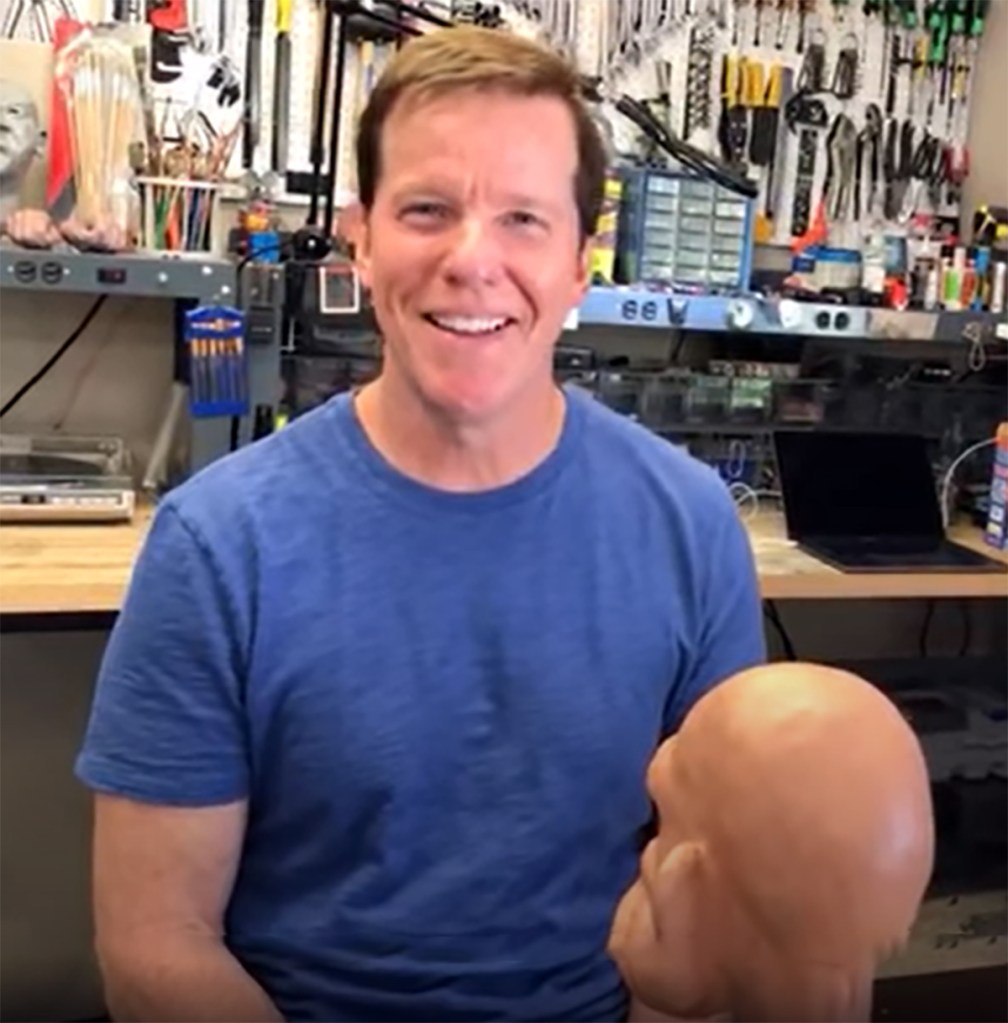
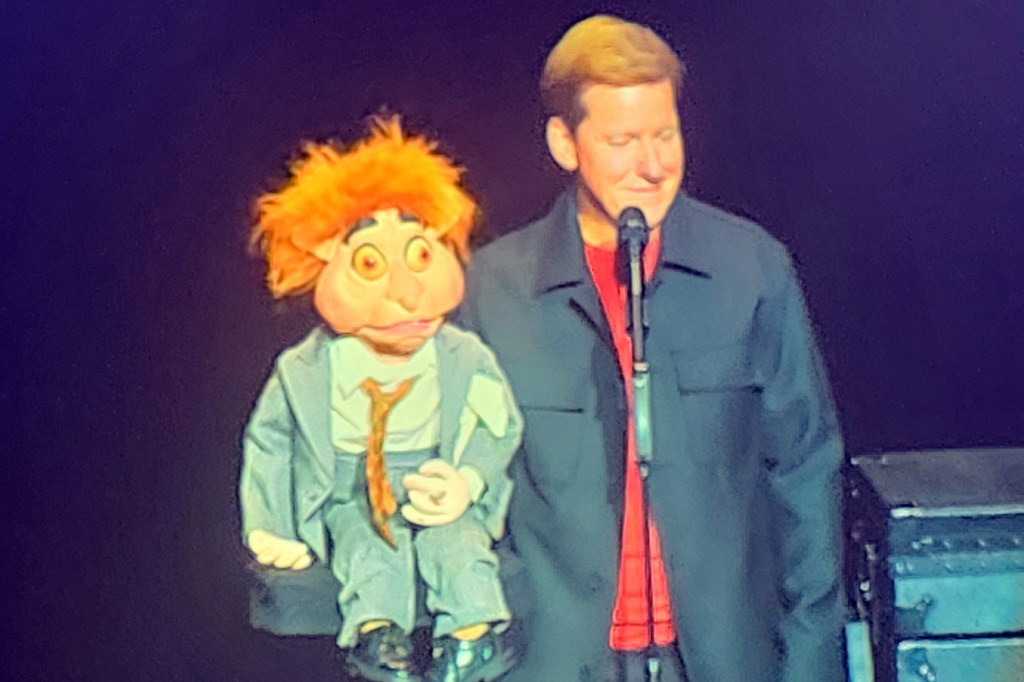
Dunham has created all of the characters in his shows. In the background you see only a small section of his tools. To top off the fabrication story, he also writes and edits all the dialogs. At the Las Vegas show we attended, he briefly introduced his next character. Meet Lenny:

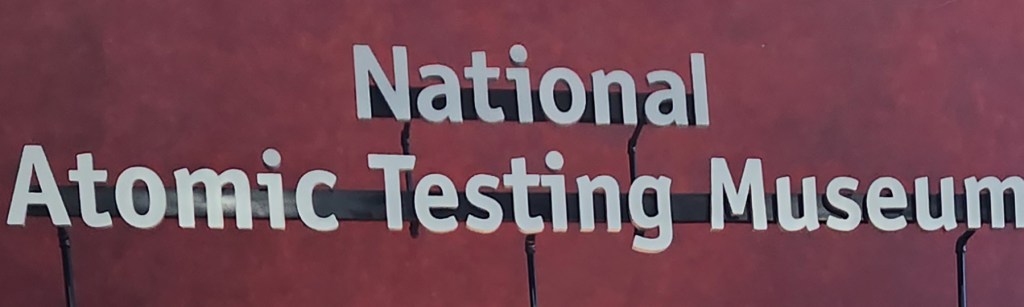
My first job after I left the Marine Corp in May of 1964 was with Reynold’s Electrical Engineering Company (REECO) the prime contractor for the Atomic Energy Commission’s test range then known as NTS the Nuclear Test Site. From the Atomic Heritage website: The Nevada Test Site (NTS), 65 miles north of Las Vegas, was one of the most significant nuclear weapons test sites in the United States. Nuclear testing, both atmospheric and underground, occurred here between 1951 and 1992. After World War II, the U.S. government established the Atomic Energy Commission (AEC) to monitor the peacetime development of atomic science and technology. The 1950s became a period of rapid expansion for U.S atomic weapons. Fear of the Soviet Union increasing their atomic weapons, and the belief that building up nuclear arms could help establish U.S. power, contributed to this rapid expansion.
When we visited the museum in May of 2025, President Donald Trump’s DOGE, Department of Government Efficiency
The following text and images are from the National Atomic Testing Museum:
- Ground Zero Theater: Simulates a nuclear explosion, providing a visceral experience of a nuclear test.
- “The Manhattan Project: Challenges and Consequences” exhibit: Features a replica of the “Gadget,” the first atomic bomb, according to the museum’s website.
- Artifacts and Memorabilia: Displays include a real (unarmed) nuclear bomb, Geiger counters, test equipment, and items related to pop culture influenced by the atomic age.
- Interactive Exhibits: The museum includes interactive STEM labs and displays that explore the science behind nuclear testing.
- Nevada Test Site History: Exhibits detail the history of the Nevada Test Site, where over 1000 nuclear tests were conducted.
- Ground Zero Theater: A 15-minute film about the upsides and downsides of nuclear testing.
- Rotating Exhibits: The museum features special exhibits, including one inspired by science fiction and its influence on technology.
- The museum also displays items related to the Cold War, the Soviet Union’s involvement with the Nevada Test Site, and even a piece of the Berlin Wall.
- Visitors can learn about the environmental and cultural impact of nuclear testing, including the geological history of the Nevada Test Site.
The time we spent there was well worth it.
-*-*-*-*-*-*-*-*-*-*-*-*-*-*-*-*-*-*-*-*-*-*-*-*-*-*-*-*-*-*-*-*-*-*-*-*-*-*-*-*-*-*-*-*-*-*-*-*-*-*-*-*-*-*-*-*-
According to the Culinary Workers Union Local 226 in Las Vegas more 60,000 are union members

-*-*-*-*-*-*-*-*-*-*-*-*-*-*-*-*-*-*-*-*-*-*-*-*-*-*-*-*-*-*-*-*-*-*-*-*-*-*-*-*-*-*-*-*-*-*-*-*-*-*-*-*-*-*-*-*-
While Geoff went his way, I started looking for an outlet to satisfy my craving for Poker. On and off since 1964 I’ve played poker in Las Vegas starting with the five-card-draw tables at the Hacienda Hotel and Casino. Maybe someday I should tell about learning to play poker before I was in High School. In the Corps, I made spending money playing “Payday Poker” in the barracks as far back as ’54 or ’55. Texas Hold-Em didn’t exist at those times. Back then
A few, maybe more, years ago I entered a modest stake poker tournament held at the Binion’s Casino. After several hours of play I ended up at the final table winning second place with a few dollars over five-hundred and a free $1,000 entry into a future tourney with a jackpot over a quarter-million dollars. I was eliminated in that one very early and went away with only the bragging rights of playing in a big one.
This trip, I was disappointed to learn that poker has all but disappeared in Las Vegas, pushed aside by flashy eight-foot tall video game machines. Only the MGM Grand and the Golden Nugget casinos still have poker rooms.
-*-*-*-*-*-*-*-*-*-*-*-*-*-*-*-*-*-*-*-*-*-*-*-*-*-*-*-*-*-*-*-*-*-*-*-*-*-*-*-*-*-*-*-*-*-*-*-*-*-*-*-*-*-*-*-*-
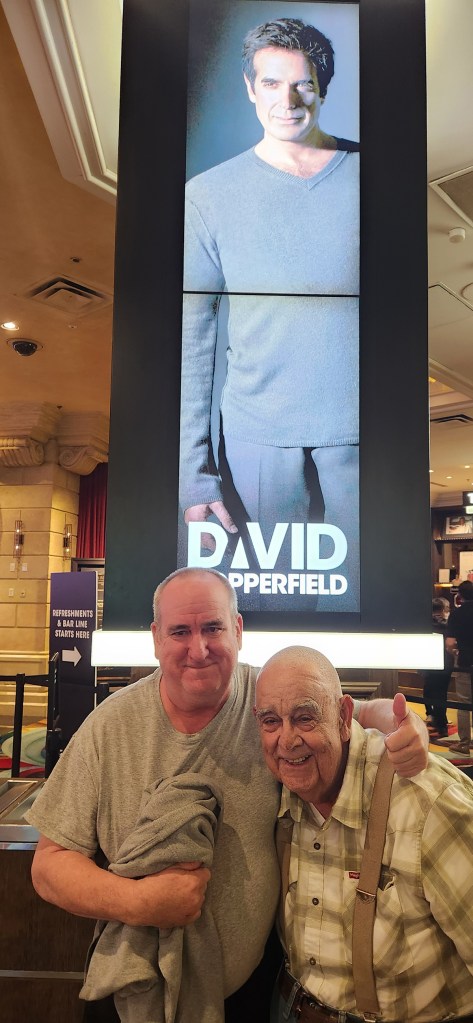
Prestidigitation, AKA magic, has always fascinated me. The VEGAS.COM website lists 20 magic shows on any one Las Vegas night and one theatre boasts of rotating a different magician each night. For our second night’s entertainment, I had a hard time choosing between Pen and Teller and the Rio or David Copperfield at the MGM. I chose the latter.
The show starts when four assistants dressed in black coveralls accompanied by preppy music roll out a four-sided square cube about 8 or 10 feet on a side. The cube sits on a frame raised above the floor and is covered with white material. The assistants open the front of the cube to show that it’s empty. After they close it up and wheel it around again two assistants walk behind the cube with bright lights to reveal no shadows inside. Then on a cue, all four sides fall open and there sits Copperfield on a sparkling Harley-Davidson motorcycle.
The magician has appeared as if from nowhere.
Above the stage a large screen projects images as Copperfield narrates an autobiographical monolog beginning with his first stuffed toy, a tyrannosaur and and anecdotes about a green Buick sedan.
Not all his magic is on the stage. Out in the audience walked down the mezzanine aisle and stopped in front of a family with a small boy. He took out a black balloon inside a clear one. tying the necks so the black one floated loose in inside. With mystical magic finger waving Copperfield popped just the inner balloon and gave the still inflated clear balloon to the child. A little farther down the aisle, he draped a large black cloth over a young man dressed in street clothes — with a flourish he whipped the cloth away to disappear the man and teleport him onto the stage.
The show show is based on mentalism and illusion, no card tricks, no wavy silks, no disappearing, reappearing milk or wine. No catching bullets/arrows in mid-air, or beautiful women prancing about the stage. All the stage hands and assistants wore simple black clothing. After several skits, including appearing his cherished Buick on stage plinths, Copperfield closed the show with a tyrannosaurus roaring out of the back shadows to meet the audience.
-*-*-*-*-*-*-*-*-*-*-*-*-*-*-*-*-*-*-*-*-*-*-*-*-*-*-*-*-*-*-*-*-*-*-*-*-*-*-*-*-*-*-*-*-*-*-*-*-*-*-*-*-*-*-*-*-
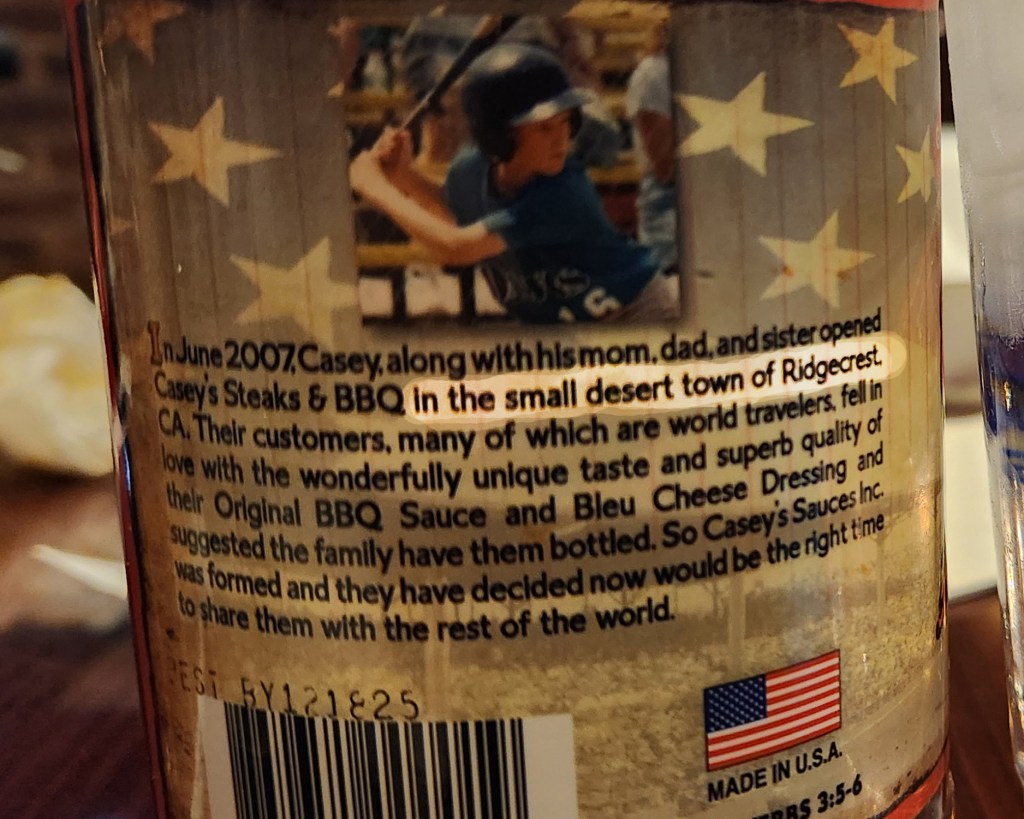
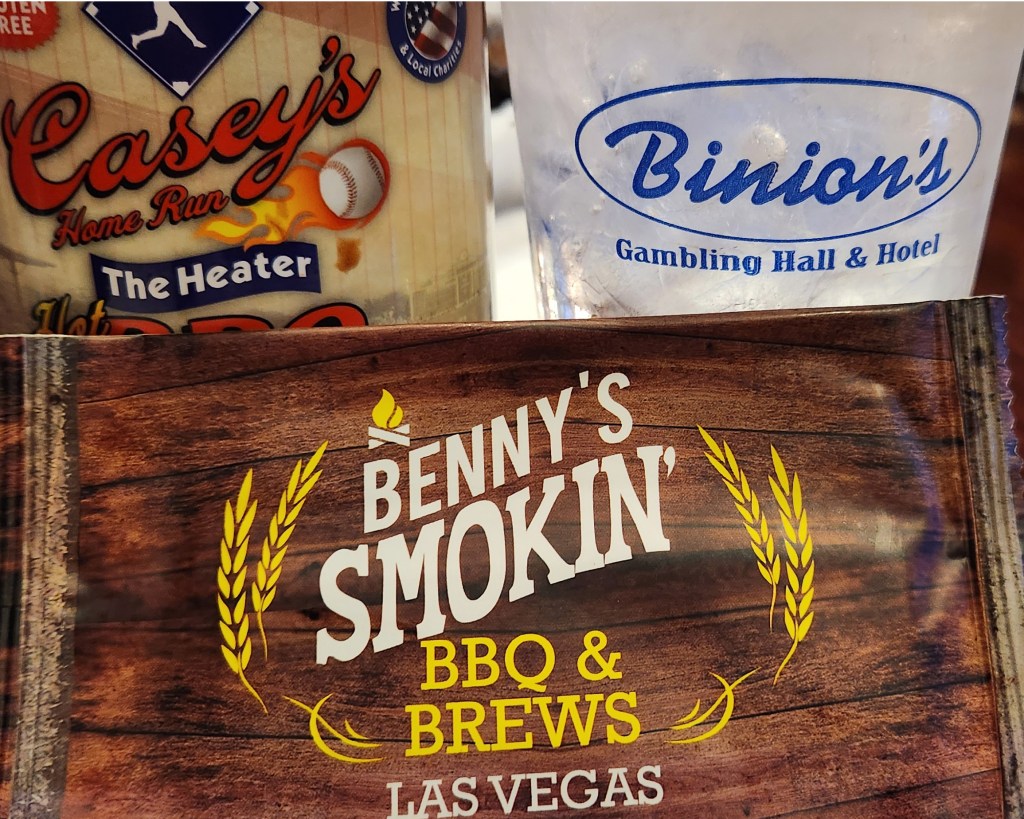
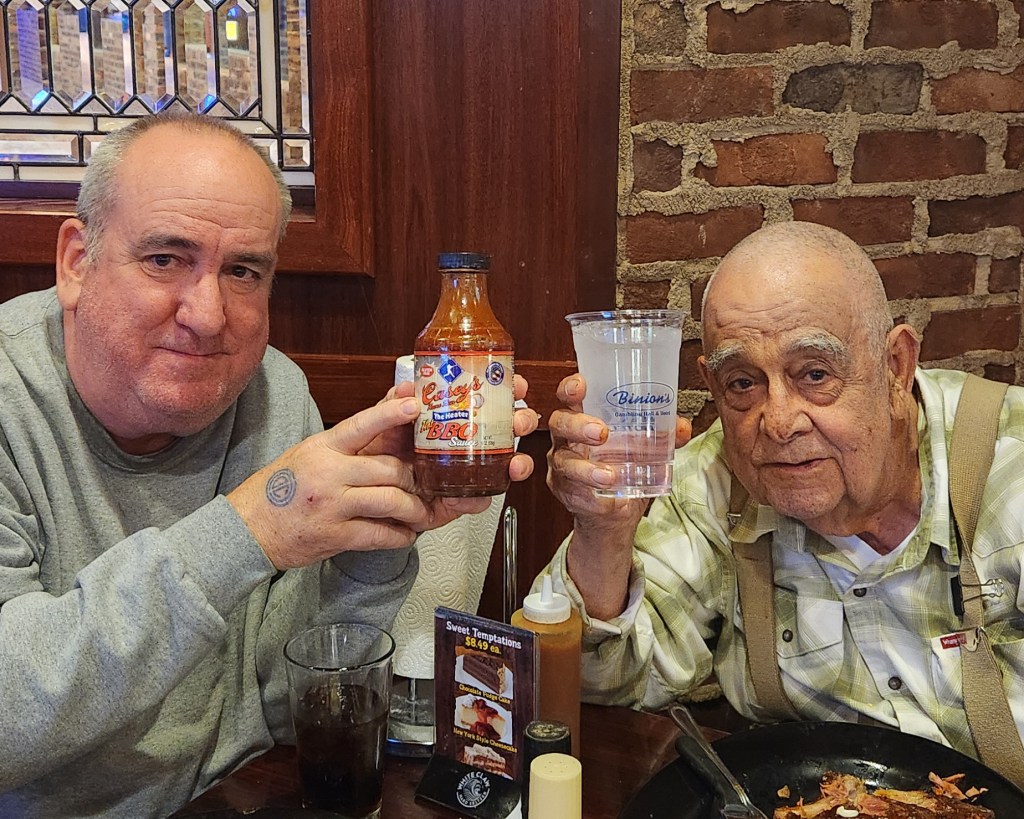
After scouting out the MGM poker room for a future visit we LYFTed back to Binion’s Cafe for dinner. We both ordered smoked ribs off the menu. When the server brought the meal to the table it came with a jar of barbeque sauce. Geoff said the logo on the front looked familiar and turned it to read the back blurb:

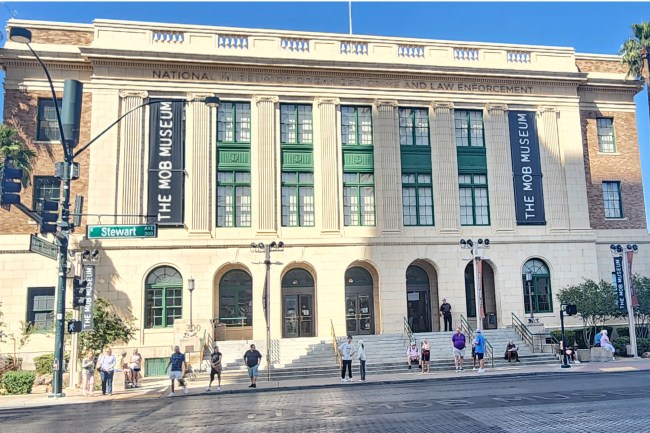
This and the following paragraph are excerpts from The Mob Museum website or Wikipedia and paraphrased to tell what, in my opinion. are the most interesting details. The photographs are Geoff’s with my narratives. Opened on February 14, 2012, the Mob Museum is dedicated to featuring the artifacts, stories, and history of organized crime in the United States, as well as the actions and initiatives by law enforcement to prevent such crimes. The museum is housed in the former Las Vegas Post Office and Courthouse, which was built in 1933 and is listed on the National Register of Historic Places.
In 2000, the federal government sold the former post office and federal courthouse to the city for $1, with stipulations that the building be restored to its original look and be used for a cultural purpose.Then-Mayor Oscar Goodman, himself a former Mob defense attorney, had the idea for a mob museum in 2002. The idea faced early opposition from Italian-American groups, while being supported by the FBI, including the former head agent in Las Vegas, Ellen Knowlton, who joined as president of the museum’s board.
The self-guided walking tour of the museum begins on the third floor with histories of how mob crime developed. The first individual widely recognized as an Italian mobster in the United States is Salvatore Maranzano. He was a powerful figure in the early 20th century in New York. In Chicago Charles Dean O’Banion, an Irishman, led the North Side Gang until he was murdered by a rival in 1924.
The museum credits the Prohibition Era for the rise of Al Capone and the Italian Mafia. Smuggling whiskey from Canada became a major industry. It wasn’t peaceful. Disagreement between rival mobs was resolved with guns.
On Saint Valentine’s Day 1929, George ‘Bugs’ Moran was late for a meeting with member of the North Side Gang. As he approached the meeting place at the SMC Cartage Company garage at 2122 North Clark Street he saw a police car pulling up to the building. Certain it was a police raid, Moran turned around and drove away; he didn’t know then that he’d probably saved his own life.
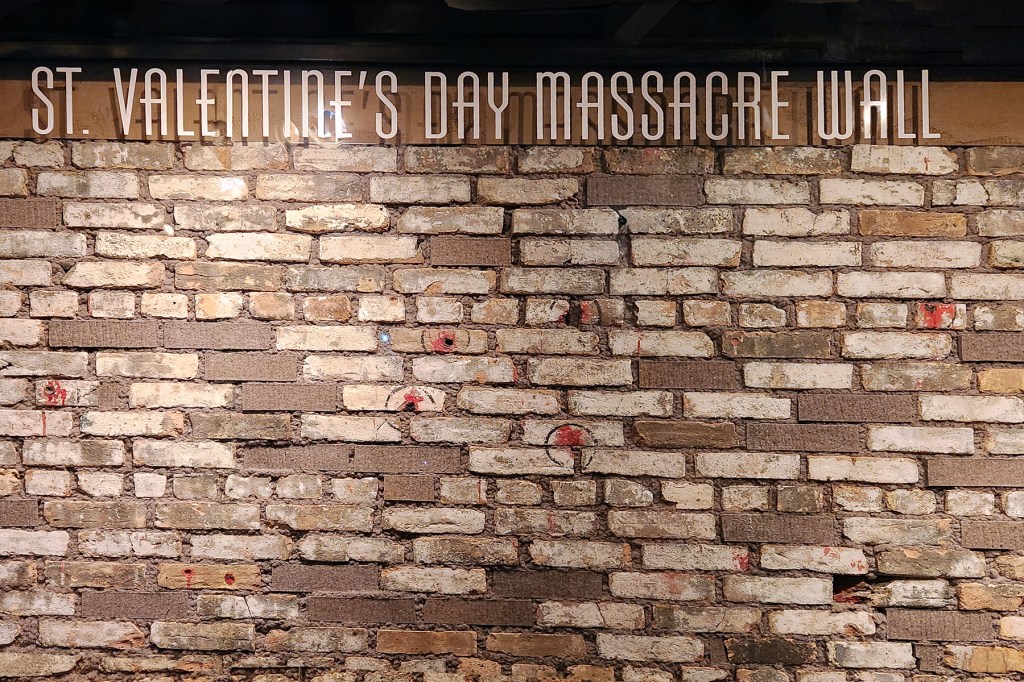
Behind him, four, possibly six men, with two wearing police uniforms began a bogus police raid. They lined up seven men associated with Moran’s gang against a wall and opened fire with Thompson submachine guns and a shotgun. Altogether, seventy rounds were fired from the Thompsons, and one from the shotgun. Six of the victims died immediately; one lived for a short while but refused to identify the killers.
When the garage building was demolished in 1967, the wall was partially preserved. In 2012 the Mob Museum rebuilt a section of the wall with 323 original bricks to make a permanent display. Pock mark from the more than five dozen bullets are visible. Some bullet holes were “enhanced” with red paint (not blood, thankfully), and a few bricks remain in storage.
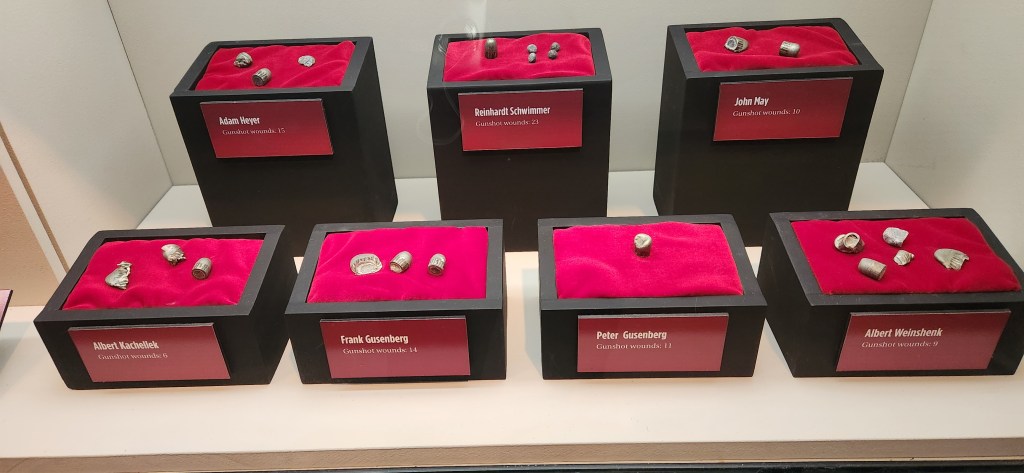
Some bullets removed from the corpses are on display. Capone’s mob was suspected as the shooters but no evidence ever linked the killings to them.
Instead of dying in a hail of bullets, Moran’s life took a slower, grimmer turn. After losing power in Chicago’s underworld, he drifted into petty crime. He was arrested multiple times for robbery and fraud, and eventually died of lung cancer in Leavenworth Federal Prison on February 25, 1957.
Geoff and I opportunities to participate in premium simulated training venues. In one case as crime scene investigators to solve an unexplained death by studying a corpse in a lab. That venue is not for the squeamish. We participated in firearms training with realistic simulation guns against criminals in video encounters and talking down a live person in a (staged) tense situation.
By the time we were done with the simulations we were ready for a drink. The last stop was to The Underground, a replication of a “speakeasy” a clandestine bar during the Prohibition era in the United States. Knock on the door in a special way or speak the secret password and you were admitted.

The Underground at the museum operates a start-to-finish distillery making real whiskey. The equipment may be modern but the products they produce are the real stuff. On the shelf to the left are Mason jars of moonshine whiskeys made to represent prohibition booze. We tasted samples of three: peach, ginger, and straight moonshine. The museum sells the booze and I bought a jar of 100 Proof to bring home. It’s sitting in my liquor cabinet until I get the nerve to taste it again. First though, I’ll have to extinguish all open flames in the house.
-*-*-*-*-*-*-*-*-*-*-*-*-*-*-*-*-*-*-*-*-*-*-*-*-*-*-*-*-*-*-*-*-*-*-*-*-*-*-*-*-*-*-*-*-*-*-*-*-*-*-*-*-*-*-*-*-
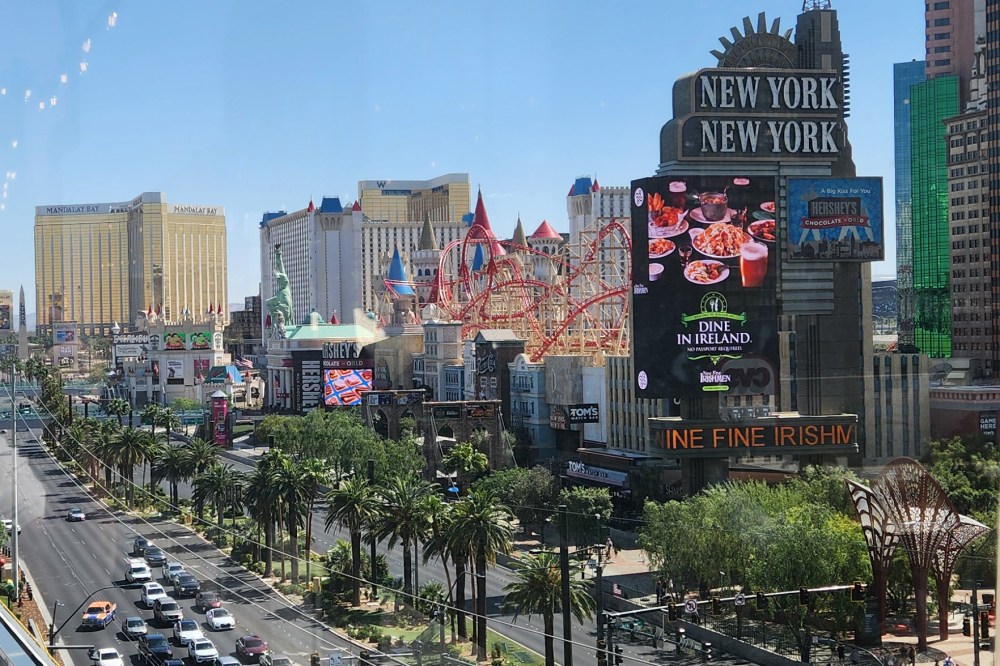
It was time for lunch when we left the museum and the tiny dollop the Underground served didn’t satisfy our thirst. We went to the Brewdog Brewery on the roof of the Showcase Mall with a great view of the Las Vegas Strip. The tables were shaded under huge umbrellas and a water-misting system kept the temperature comfortable in the light breeze. Geoff made a decision on one of the myriad IPAs brewed on the roof, but I had no idea what to order. The server made me an offer. He would bring me an IPA and if I didn’t like it, he’d bring me a different one, no questions asked, until I found one I liked. I settled on that first one. Beside the beer, we enjoyed a couple of burritos, by the way.
-*-*-*-*-*-*-*-*-*-*-*-*-*-*-*-*-*-*-*-*-*-*-*-*-*-*-*-*-*-*-*-*-*-*-*-*-*-*-*-*-*-*-*-*-*-*-*-*-*-*-*-*-*-*-*-*-
Next Stop
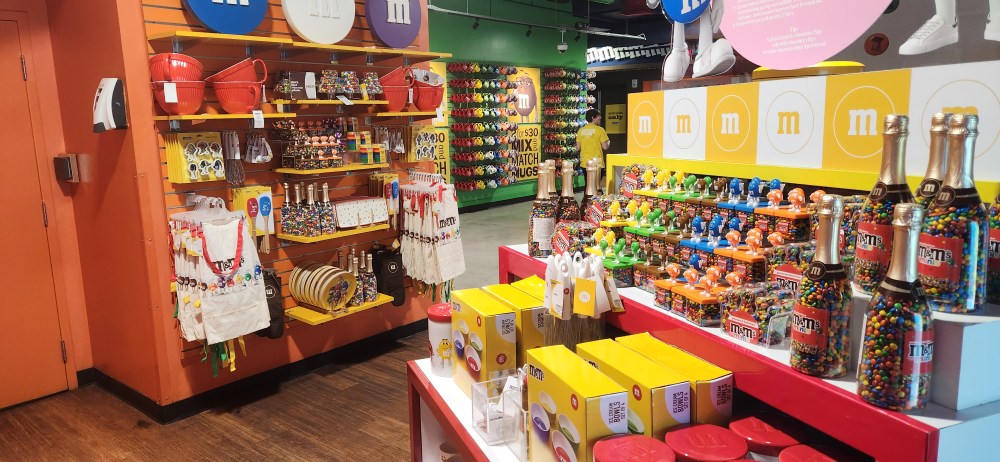
The name is a little play on the place in Nevada called Area 51. It is an entertainment complex just off the “Strip” in Las Vegas. It was developed and is owned by a company called Meow Wolf — it has a handful of similar places around the country. I have no idea about the name nor origin of the name or the company itself for that matter. I know it as a corporate sponsor of KNPR, the Nevada/Las Vegas station of National Public Radio, of which I am a frequent listener and a subscriber. I had heard of it during numerous pledge drives and thought, “Why not see what’s there…”
The area consists of several buildings which include some kind of indoor golf driving range maybe and a thing called “The John Wick Experience”. I can only assume it’s some kind of escape room adventure with a theme based on the movies. Yikes. There are VERY many other things to do there. What I mentioned are just from the signs on the buildings.
The main building consists of a candy store and several bars, and a hanging “race track”/zipline. One bar (not active when we were there) seemed to be a “loungy”, lay back in your chair and watch something projected on domed canopy over the drinking area. Whatever. Another bar that caught my attention was one that, with a cover charge included axe throwing. I don’t know about other people reading this, but that seems to me to be a bad combination…,
The main attraction in this gargantuan building is called “Omega Mart”. It is, to say the least TOTALLY FREAKY and BIZZARE. It is a little science fictionous and VERY surrealistic. It also an art exhibit fitting into the theme. Google it for more info.
Upon entering the first floor of this place we were greeted with what seemed like a grocery store type environment. The thing is… 90% of the stuff on the shelves is fake and glued down. The product names were humorous and dopey.
The real adventure is on the second floor. The entire place is a giant interactive puzzle starting at walking in the front entrance downstairs (something I was not aware of when we got there). I suppose it can be considered a giant escape room, but there is not a threshold of puzzles to be solved to move on. It could be called a “Choose your own adventure” type puzzle.
Unfortunately, I did not discover the puzzle aspect until Dad and I had wandered through way more than a third (maybe even half) of the second floor. We came across a video monitor with a little pad with a little glowing symbol and a message that said, “Boop Here”. I then remembered upon entering the place I was handed our two VIP (‘cause that’s how we do it) credential lanyards and a card that also said , “Boop Here”. It didn’t make sense at the time so I just pocketed it.
When I “Booped” it – and that is the sound it makes – the screen gave me a clue where to go next, or the next thing to do, I don’t remember. After that, I kept a look out for other “Boop” pads, and there were a lot. Every time I booped, I got a clue or instruction. At one point we got to a room that contained a good number of computer monitor each with a boop pad. Unfortunately every time I booped one it said something to the effect that I had not accomplished this task, or that task, and could not access what the computer had next.
By that time we had wandered through almost, if not all, of the “game” floor, and I didn’t know where to restart the sequence of clues. We were hours in, and I didn’t want to start over. Mybe next time I’m in Vegas I’ll go back and try again from the start. I was told my “boop” card is valid in perpetuity.
We bailed the second floor and went down to the bar called Datamosh. When I got the tickets to Omega Mart purchased an add-on for a couple drinks. The drink menu, as you might expect by now had some interesting named beverages. I picked something weird, and Dad settled for a Manhattan. They were strong-ish. What I didn’t realize was when I read the description of the VIP tickets I bought, the included beverage was NOT the soda or iced tea or lemonade I thought it was going to be. It was a drink AT THE BAR. So round two. I wish I had pictures of one of the drinks I had, because it had a cloud of vapor inside a bubble on top of the glass. It was very cool.
Then we left. It was a good thing we did a ride share.
-*-*-*-*-*-*-*-*-*-*-*-*-*-*-*-*-*-*-*-*-*-*-*-*-*-*-*-*-*-*-*-*-*-*-*-*-*-*-*-*-*-*-*-*-*-*-*-*-*-*-*-*-*-*-*-*-
The Sphere
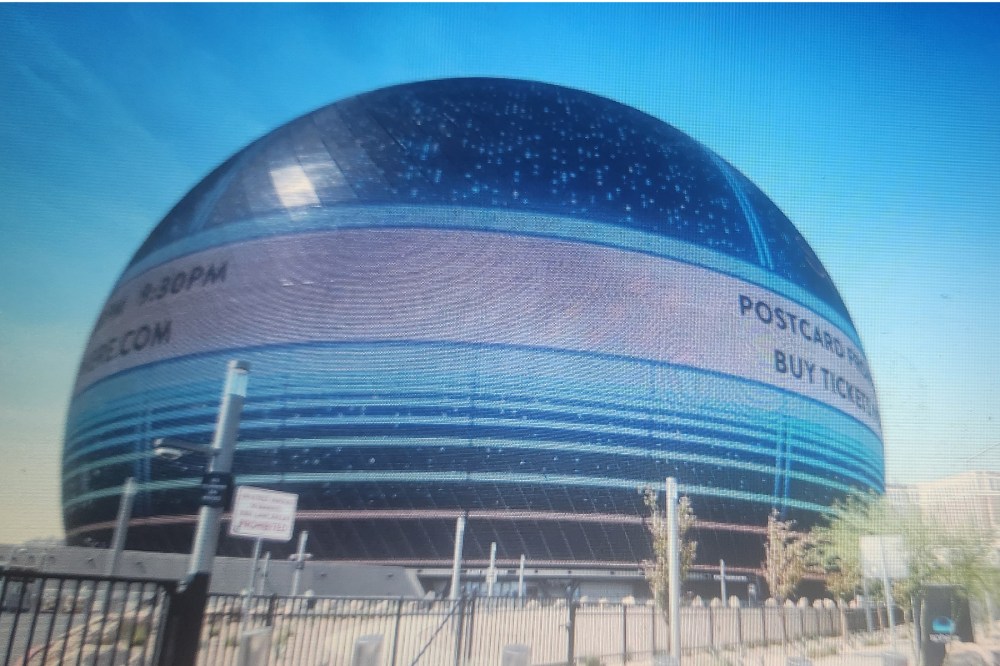
In a proverbial nutshell, the Sphere is a huge movie theater with some high-tech exhibits in the lobby with many opportunities for snacks and drinks. Geoff purchased us center seats halfway up, just about dead center of where a traditional theatre screen would be. This video doesn’t show the full seating capacity, more than 17,000. Notice that the “stage” below the screen wraps around, like but wider than IMAX. In the following videos you’ll see how the screen’s total projected area is more than 15 times larger than typical IMAX screens. The promotions for the Sphere speak of haptics in the seats and winds blowing across the audience. I was too engrossed in the visuals to notice them. Just click on the images.
I used Google’s AI to compare The Sphere to IMAX: The Las Vegas Sphere and IMAX both aim to immerse audiences—but they do it in radically different ways. Here’s how they stack up:
| Feature | Las Vegas Sphere | IMAX |
| Screen Type | 16K wraparound LED dome (160,000 sq ft) | Flat or curved projection screen (up to 1,000 sq ft) |
| Visual Immersion | Full-field vision with overhead and peripheral coverage | Focused central viewing with high resolution |
| Audio Experience | Beamforming, wave field synthesis, haptic seat feedback | Powerful surround sound, but less tactile |
| Sensory Effects | Wind, vibration, and motion synced with visuals | Limited to audio-visual only |
| Content Format | Custom-made films (e.g. Postcard from Earth) | Standard theatrical releases, documentaries |
| Venue Size | Seats up to 17,600; 366 ft tall, 516 ft wide | Varies by location; largest seats ~600 |
| Camera Tech | Big Sky 316MP 18K camera with 270° lens | IMAX 70mm or digital cameras |
| Experience Type | Multi-sensory, panoramic, futuristic | Cinematic, narrative-driven, traditional |
-*-*-*-*-*-*-*-*-*-*-*-*-*-*-*-*-*-*-*-*-*-*-*-*-*-*-*-*-*-*-*-*-*-*-*-*-*-*-*-*-*-*-*-*-*-*-*-*-*-*-*-*-*-*-*-*-
In between the major experience venues, Geoff explored the Freemont Experience while I visited the two remaining poker venues in Las Vegas. The first time I brought my camera out inside a casino, a security person appeared and waggled the NO NO finger at me before I could press the shutter button.
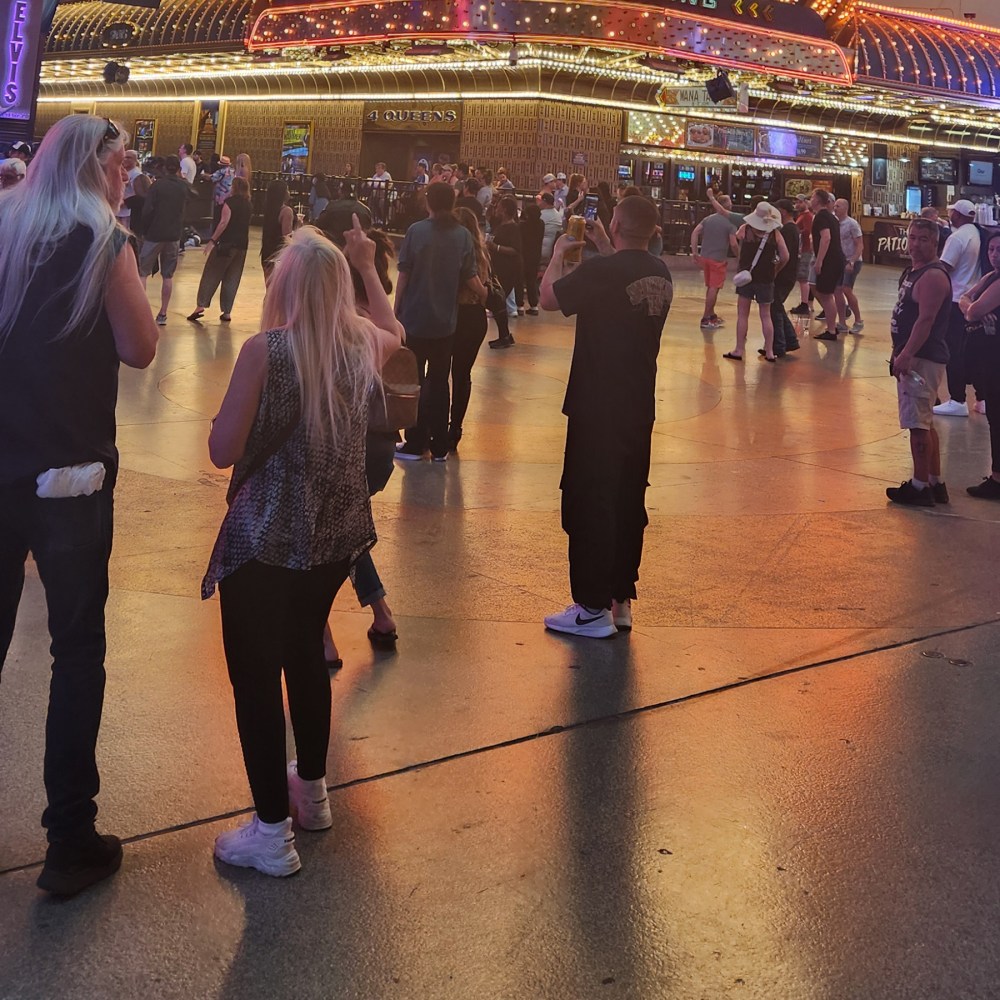

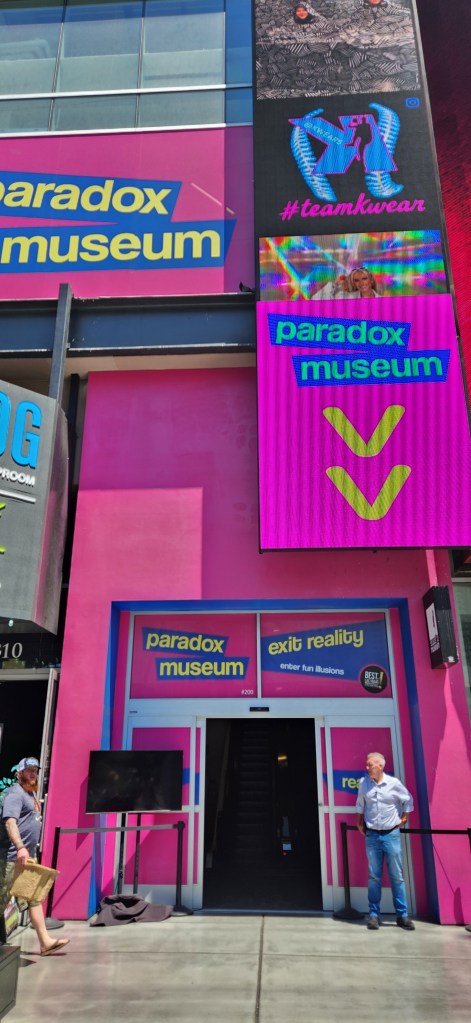
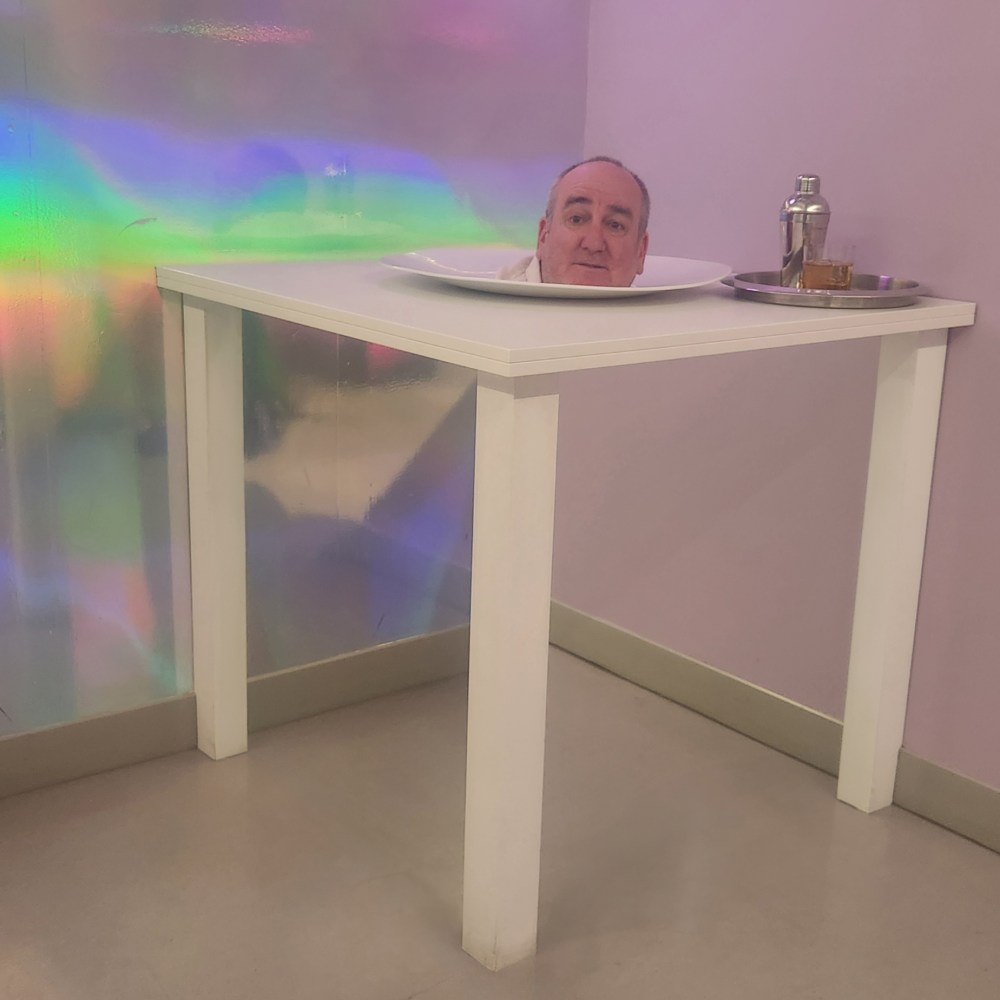
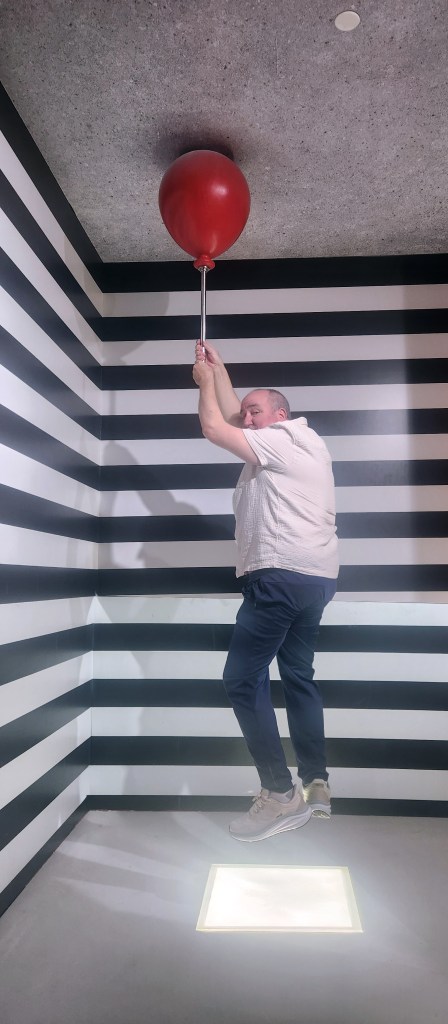
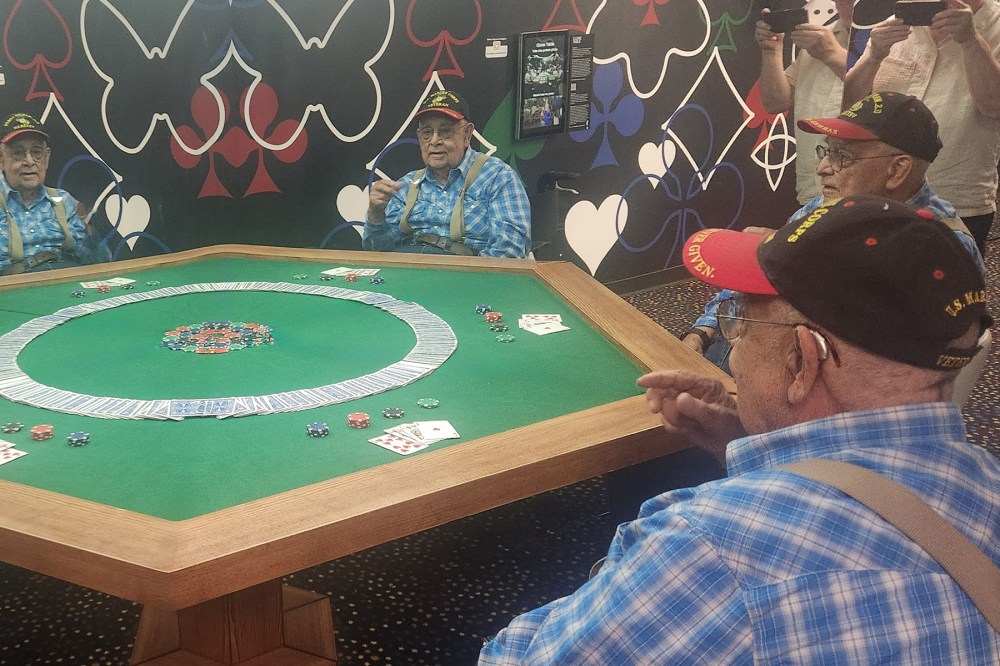
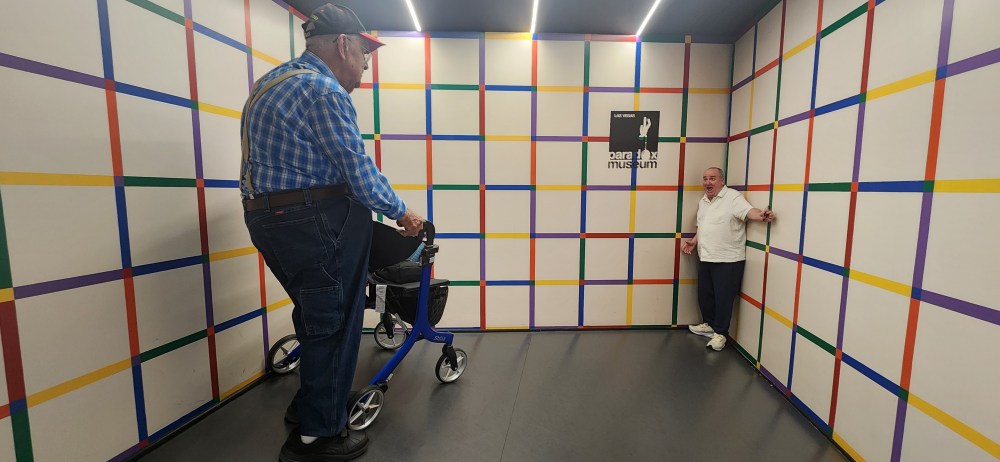
Whether going here was serendipity or Geoff had this on our itinerary this was a fun FUN stop. Dozens of optical illusions and special effects will do funny things to your brain and balance.
-*-*-*-*-*-*-*-*-*-*-*-*-*-*-*-*-*-*-*-*-*-*-*-*-*-*-*-*-*-*-*-*-*-*-*-*-*-*-*-*-*-*-*-*-*-*-*-*-*-*-*-*-*-*-*-*-
Our Last Experience
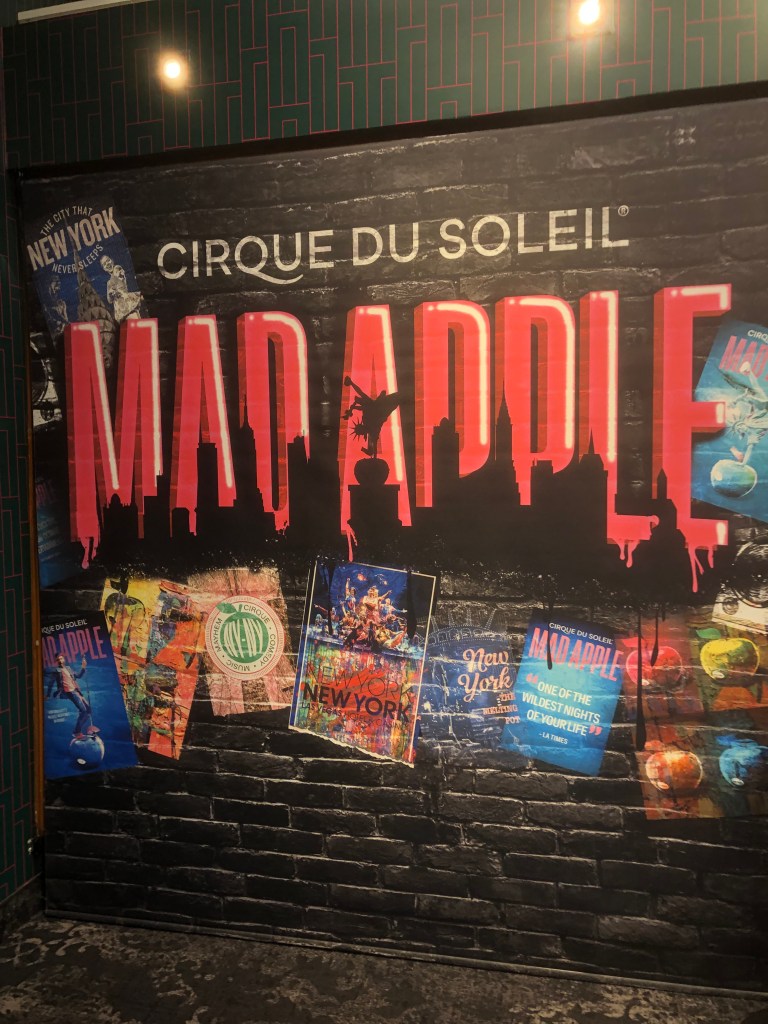
As the house lights dimmed Mad Apple, Cirque du Soleil’s newest feature, opened with a juggler snatching up boxes the size of a large brick with one hand while collecting the boxes in a growing string defying gravity in the other hand. It gave me the impression of a warm-up act before the main show.
Other Cirqe shows — Mystere, O, and Ka — tell stories dramatic with beginning, middle, and ending. Written programs provide synopses. Mad Apple had none of those.
The juggler was the first act in a 90-minute variety show avout New York City nightlife with Las Vegas spectacle. Set in the New York-New York Hotel & Casino, it’s a cocktail of acrobatics, live music, edgy stand-up comedy, and dynamic dance routines. Each act channels a different slice of NYC—from subway performers and fashionistas to basketball dunkers and rooftop dreamers. The show opens with a pre-party at the stage bar, where the audience can mingle with cast members and sip high-priced themed cocktails. Unlike the traditional Cirque productions, Mad Apple leans into adult humor and pop culture, creating an experience that is supposed to feel more like a night out than a theater show.
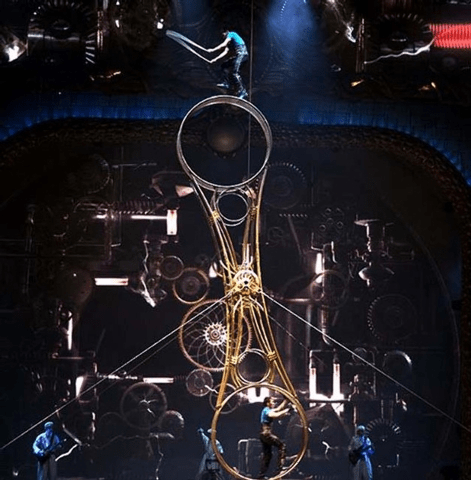
(Image borrowed from a Cirque road show)
The show was not without acrobatics and other circus-like acts. Mad Apple amplifies the Cirque du Soleil formula with a rebellious twist—think less ethereal fantasy, more urban adrenaline. The show’s standout acts include the Wheel of Death, a jaw-dropping acrobatic feat that somehow exemplifies New York night life, and The Game, a basketball-inspired segment that supposedly channels NYC’s street culture. Loud live music pulsed throughout, with covers, according to the Mad Apple producers. of iconic tracks from artists like LL Cool J and Donna Summer, while dancers and aerialists blur the line between athleticism and artistry.
Objectively, it’s only fair to admit that I am from a generation before generations were given names and “Rock and Roll” did not apply to music. I’m not going to tell you to not buy tickets to see Mad Apple, but don’t expect the see the old-fashioned Cirque du Soleil.
-*-*-*-*-*-*-*-*-*-*-*-*-*-*-*-*-*-*-*-*-*-*-*-*-*-*-*-*-*-*-*-*-*-*-*-*-*-*-*-*-*-*-*-*-*-*-*-*-*-*-*-*-*-*-*-*-
After running up a three-digit bill for a four-course dinners in Binion’s rooftop restaurant we retired for the night. The next morning we dusted off the car and drove home.
Travel note: When we drove north to Vegas on I-15 on Sunday, the southbound traffic on the other side was crawling along bumper-to-bumper for what looked like miles with people headed home. We saw the opposite travel nightmare when we headed home.
 A Freelance Writer's Blog